Tuesday, 29 March 2011

Contact based on Carl Sagan's book

Have you guys watched a film called Contact? A very interesting film. If I were you, I would watch it. It's based on the book of Carl Sagan. I always say to my husband that this film is about God and that's why I like it, but he always says that this film is about Science and that's why he likes it...maybe it's about both. 
I will tell you how I see it. The film is about scientists that want to discover if there is life in other planets (sensitive subject for many). The main scientist is Jodie Foster and she is the most skeptical scientist of all of them. She doesn't believe in God and, in fact, she thinks God is a creation of the human mind to comfort us when we have problems. But then she meets a religious men and they get involved. Jodie Foster's character goes through an experience and when she comes back from that experience, no one believes her story because she doesn't have proof of what she's seen and what she's heard. She had a camera with her that only recorded statics and the project she was involved in seemed to have failed, but she experienced something. 
The funny and great thing about this film is that every penny of skepticism she gave to religion came back to her after the scientists panel (the panel where she once belonged to) asked her when she went to an official meeting to defend her story: "Do you expect us to believe your story on faith?" That was exactly what she was expecting as a scientist that couldn't prove what she's seen and heard. And yet, the only people who believed her were religious and all her scientists fellows turned their back on her.
There is another bit of the film that I find great. When Jodie Foster's character was a little girl, she asked her father: "Do you think that there is life in other planets?" Her father answered: "If there isn't, it seems an awful waste of space." 
This movie makes me think and wish that scientists find the answers they are looking for sooner than later. We will all be in the same page when they discover the truth that has always been in front of them the whole time ;) 
That's the film trailer for you below.
Take care! 

Mrs. P 

Tuesday, 22 March 2011

The greatest of the commandments

Yesterday I posted something about having faith in men as well as in God. Then I read on Facebook afterwards something that made me doubt that humanity or men deserve to be honoured with any one's faith. One girl wrote a message on Facebook showing that she was actually proud of being part of the reason why someone quit their job. I understood that she was this person's superior and she posted on a social network that this situation made her a little bit proud. My God, it is so hard to not judge people and yes, I am so wrong in doing so, but, for heaven's sake, what was she thinking? What drives someone to be proud of something like that? And, even more sad, it's to see that she doesn't only feel proud of that but she also doesn't care about the other human being who took this decision because she contributed somehow to it. It wasn't probably an easy or good decision for that person and it could have been this girl in her shoes, but she doesn't even give it a second thought. Remember my post about the use of good or bad authority? I totally remembered it! Maybe I shouldn't have said anything to her at all...after all, I don't know what happened between these two people and their consciousness is to be judged by God only. But I have this terrible urge to just express my mind and my feelings, especially if something seems so unacceptable and wrong to me! Maybe one day I will learn how to silence my urges...
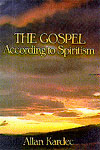
I opened the Gospel according to Spiritism book right after that to see which message I would get and it was the message below. It is a good one.
Take care! 

Mrs. P 


THE GREATEST OF THE COMMANDMENTS
 

4. But when the Pharisees had heard that He had put the Sadducees to silence, they were gathered together. Then one of them, which was a lawyer, asked Him a question, tempting Him, and saying, Master, which is the greatest commandment in the law? Jesus said unto him, Thou shalt love the Lord thy God with all thy heart, and with all thy soul, and with all thy mind. This is the first and great commandment. The second is like unto it, thou shalt love thy neighbour as thyself. On these two commandments hang all the law and the prophets (Matthew, 22: 34-40).
 
5. Charity and humility, such is the only path to salvation. Selfishness and pride are the paths to ruin. This principle is found to be formulated on the following precise terms: "Love your God with all your soul and your neighbour as yourself; all the law and the prophets are contained in these two commandments." And so there would be no mistake in the understanding of the meaning of the love for God and for our neighbour, He then added: "And there is the second commandment, which is similar to the first." This means that it is not possible to truly love God without loving your neighbour, nor to love your neighbour without loving God. Straightaway, all that you do against your neighbour you also do against God. Therefore, as it is not possible to love God without practising charity towards one's neighbour. All of mankind's obligations are resumed in the maxim: without charity there is no salvation.
 
THE NEED FOR CHARITY ACCORDING TO SAINT PAUL
 
6. Though I speak with the tongues of men and of angels, and have not charity I am become as sounding brass, or a tinkling cymbal And though I have the gift of prophecy and understand all the mysteries and all knowledge; and though I have faith, so that I could remove mountains, and have not charity, lam nothing. And though I bestow all my goods to feed the poor, and though I give my body to be burned, and have not charity it profiteth me nothing. Charity suffereth long and is kind, charity vaunteth not itself, is not puffed up, do not behave itself unseemly, skeet not her own, is not easily provoked, thinketh no evil, rejoiceth not in iniquity, but rejoiceth in the truth; beareth all things, believeth all things, hopeth all things, endureth all things. And now abideth faith, hope, charity these three; but the greatest of these is charity (SAINT PAUL, I Corinthians, 13:1-7 & 13).
 
7. This is the way in which Saint Paul understood this great truth, which said: 'When I have learned the language of the Angels; "When I have the gift of prophecy, which I can penetrate all the mysteries; When I have all the faith that is possible, even to the point of transporting mountains, if l do not have charity, then lam nothing. Within the three virtues: faith, hope and charity, the most superior of these is charity." In this manner and without any possible doubt, Paul places charity above even faith. This is because charity is within the reach of everybody, from the ignorant to the wise person, from rich to poor people; it is also quite independent of any particular beliefs. He does even more: he defines true charity by showing it as being not only beneficence, but also a collective of all the qualities of the heart, in terms of goodness and benevolence towards all of our fellow beings.

Message from the book Gospel according to Spiritism by Allan Kardec from the chapter "Without charity there's no salvation". 


Sunday, 20 March 2011

Ghandi's non-violence speech

Today I was thinking about what is going on in Libya. Why can't that man just quit? What makes him think that he is so important to people that he can't quit or doesn't want to? Why is the world divided between Western and Arab right now? Everybody is the same, so what is with the separation? I don't like that!
I was also thinking that, when I die, I just want people to remember me as a person like everybody else independently of my nationality, my culture and my beliefs. I just want people to pray for me and forgive my mistakes when it's my time to go...
Yes, culture is part of our identity, but culture is not the most important thing about us, it doesn't define who we are as a whole, especially if cultural differences are used to separate and divide people in any way. I'm proud, at the moment, that Brazil decided to not participate in this military intervention in Libya. I'm not sure what should be done, but violence shouldn't be the right answer to anything. People in Japan are struggling because of natural disasters and money seems to be in the process of being wasted in this military no- fly zone intervention. Is it really sensible?
We need to pray...a lot!! Maybe we just need another Gandhi to help us see that non-violence also gets results. Maybe, if there was another leader like him in Libya, people there would be able to fight Gaddafi without international help. We need to fight our own battles, but it doesn't need to be with violence. I just pray that God helps them and us to understand that a new era is coming and that we should start changing ourselves first inside...not outside us. It makes me feel hopeless to not be able to do anything directly for them, but I believe that faith can do wonders. Where is our faith? If not in God, why not in humanity at least? Men deserve our faith as well. Humanity and individuals can change if they want to. Nothing can express my thoughts better, at this present moment in time, than the passage from the Bible when a men answered Jesus saying: "I believe, help my unbelief" (Mark, 9:24).

I decided to put a video that is part of the film about the life of Gandhi here today (below). I so respect this man! It's a good time to remember him, I think! Hope you see his point...I sure do.

 Mrs. P


Thursday, 10 March 2011

The good or bad use of authority

 Sometimes I wish a different world to all of us...don't we all? A world where money, status, financial position, material things and appearances wouldn't be so important. If you are religious or not, it doesn't matter: no one will be able to take anything with them after death apart from whoever they became with their experiences. That's a lot to think about if you give it a proper thought.
I worked in many places where I saw so many people being humiliated for many reasons, but mainly because they didn't have the money, the power or the status to be respected or to be treated decently by people above them. Bosses, owners, managers, wealthy people can be extremely petty, spoiled and childish, sometimes, just because they have the power to be it. It always bothered me to see someone being pushed down, not receiving the recognition or the respect they deserved as human beings because they didn't have the final saying...maybe it bothered me to see it happen to others more than when it happened to me! Sometimes it's difficult to have money, power and everything else that comes with it and be a leader, I understand that. Pressure, competition and keeping up is not easy for anyone and I appreciate that leaders, owners, managers, bosses in general have also great responsibilities over their shoulders and leading people anywhere is not a walk in the park. I ask myself if I would be able to impose myself  to others through humiliation and intimidation to be able to get the results I needed if I was someone with power, money and everything else that comes with it. There's no way to know unless you've been there and I haven't. But it makes me sad to think that people in leadership and holding the power, at the moment, think that humiliating and intimidating is the best they can do. Let's try not to judge anyone, but I ask myself why this would be necessary. How many times I asked myself if it wouldn't be easier for everybody if the leaders and the ones "in power" would do us the favour of giving the examples first and then expecting things from others afterwards. How can you be respected by anyone by making people work their hardest for you while you watch them do it and take the credit? How can you expect to be fair acting this way? If you would like to be treated fairly by others, why can't you be the first one to treat others fairly?
I am talking about work because of one of my favourite messages from Cardinal Morlot from the book Gospel according to Spiritism that is called THOSE WHO ARE SUPERIOR AND THOSE WHO ARE INFERIOR. It talks about authority and the use we make of it, so I couldn't help thinking about work in general with human beings!!!
I started talking about bosses, leaders, owners, the powerful and the wealthy, but don't forget that, every single employee or subordinate also have their moral obligations. Lack of power and money doesn't make us victims. Employees cannot steal their money from somewhere, they have to work for it. If you don't do what you know you should, that means you're stealing from your employer, not working. Stealing doesn't necessary mean only material things! We do have also the responsibility to work for our salary and not pretend to work. An awful boss doesn't justify lack of hard work and dedication from the employees. Can you visualise both situations happening at your work place? I am sure that, in every work place (no exceptions!), there is that employee who doesn't do anything, but somehow always gets the promotion or the attention. Luckily, the same lazy co-worker won't be a back stabber!!!! There is also those bosses that take the credits for their leadership and etc when, in fact, they don't have a clue about how things are done and how the results were achieved! Luckily, some bosses are not bullies!!! The incredible part is that everybody sees what happens, but everybody pretends they don't!  How human beings are complicated!!!
Wouldn't be great if everybody just did what is right independently of other people's attitude? Because, at the end, it's only this that we are going to take with us: our actions, our thoughts, our consciousness and our story...
I watched a film the other day that is called Extraordinary Measures. It is about money, power and work, but focused on the Pharmaceutical industry. Good film with Harrison Ford playing a scientist. His character said something that I really liked. He said: " I don't care about money, I am a scientist. I have more important things to care about!!!!" I totally got his point!
Let's all be careful to not do to others what we don't want others to do to us. Let's also be careful to do our part, no matter if others are doing their part or not. Nobody is saying it will be easy!!! Always remember what we can take with us and what we can't!!! 
I am copying the message from Cardinal Morlot for you below. If you want to read Gospel according to Spiritism, you can go to my previous post to click on the link for this book there. If you would like to read other Spiritist books, you can go to this site here:  www.oconsolador.com.br There are various books in english and in portuguese for you to read for free!!! 

I hope you enjoy this message and think about it! 
Take care! 

Mrs. P 


THOSE WHO ARE SUPERIOR AND THOSE WHO ARE INFERIOR 

Authority, just as much as fortune, is delegated; and those who have received it will be required to give an account of what they have done with it. Do not believe that it has been given for the futile pleasure of command, nor even less as a right or property, as is falsely thought by the majority of powerful people on Earth. Besides, God is constantly proving that it is neither the one nor the other, since He takes it away whenever it pleases Him. If it was a privilege inherent to the person who exercised it, it would be inalienable. However, no one can say that something belongs to them, when it may be taken away without their consent. God confers authority with the title of mission or test, as He sees fit, and takes it back in the same manner. For the depository of authority, whatever its extent may be, from the master over his servants to a sovereign over his peoples, it must never be forgotten that such people have souls in their charge, and will have to answer for both the good and bad directives given to these subordinates. The misdemeanours these may commit, and the vices to which they may succumb in consequence of the directives received or the bad examples given, will all revert to those in command; just as in the same way the fruits of the solicitudes offered in conducting these subordinates towards goodness will also revert to those in authority. Every good person on Earth has either a small or a great mission, and whatever form it may take, it is always given for the purpose of goodness. Therefore to turn it away from its purpose is to fail in the execution of the task. If God asks the rich man: "What have you done with the fortune in your hands which should have been a source for spreading fruitfulness all around you?", He will also inquire of those who have some authority: "What have you done with your authority? What evils have you avoided? What progress have you made? If I gave you subordinates it was not so that you could turn them into slaves to your desires, or docile instruments for your whims or your greed. I made you strong and entrusted to you those who were weak, so that you could protect them and help them to climb up towards Me." The acting superior, who keeps Christ's words, despises none of his subordinates, because he knows that social distinctions do not exist before God. Spiritism teaches him that if these people are obeying him today, perhaps they have already given him orders in the past, or may give them to him later on, and that then he will be treated in the same manner as when they were under him. If the superior has duties to be fulfilled, the subaltern also has duties on his side which are no less sacred. If this person is also a Spiritist their conscience will tell them, in no uncertain terms, that they are not exempt from fulfilling these duties even when their superior does not fulfill his, because they know that you do not repay evil with evil and that the failings of some do not authorize others to fail likewise. If they suffer in their position, they will comment that without doubt they deserve it because they have perhaps abused the authority they had been given at some other time, and that now they are feeling the disadvantages that they had made others suffer. If they are obliged to support this situation for want of a better one, then Spiritism teaches them to be resigned as a test of their humility which is necessary for their advancement. Their belief guides them in their conduct; inducing them to proceed as they would wish subordinates to behave towards them, if they were the superior. For this reason they are more scrupulous in the fulfilment of their obligations, as they understand that all negligence in the work which has been confided to them would cause a loss to the one who pays them and to whom they owe their time and effort. In a word, this person is guided by their sense of duty, which their faith has instilled in them, and the certainty that all turning aside from the straight and narrow pathway will be a debt incurred that must be repaid sooner or later.
FRANÇOIS-NICOLASMADELEINE,  Cardinal MORLOT (Paris, 1863).

Message from the book Gospel according to Spiritism by Allan Kardec, chapter 17 "Be perfect".


Tuesday, 8 March 2011

From the chapter I have not come to destroy the law


The title of this book (Gospel according to Spiritism) is not inviting to many people, I am sure, but it is a very interesting book if you give it a chance. Many people reject any thoughts of reading a religious book because there are so many annoying religious people around trying to force us or bully us into believing in God and in their religion. That's not my intention at all by posting things about God and these religious books. But I do like to read and think about God to get to my own conclusions with no prejudice. People can be used to dismissing everything that includes Jesus, New Testament or Bible immediately because these things are associated to boredom, disbelief, wars and annoying religious people...I know it happens because it happened to me to a certain degree at the beginning of my studies of Spiritism. I truly think it can be fascinating to analyse the explanations and theories in Allan Kardec books about God. I am really into God at the moment as it has been a phase of introspection to me, especially after I have been to Israel...I've been thinking and thinking, non stop! Great trip!!! I remember that a nice tour guide who was Jewish in Israel made a joke that was really funny. He said: "Jewish people pray 5 times a day, Muslims pray 3 times a day and Christians...well, once in a while, when they remember!!" It might be just me, but I thought it was hilarious!!! It can be so true!! But I will ask you a question: Have you ever thought how difficult it is to live what you preach instead of only preaching? Is it easier to only pray or is it easier to put what we believe in and pray for into practice?


Gospel according to Spiritism is one of the books from Allan Kardec and it talks about the New Testament and the teachings of Jesus Christ as much as it talks about Spiritism. This book is based on passages of the Bible. Sometimes people interpret the Bible in a very strict and "set in stone" way. The Bible is a sacred book for many reasons, but men can interpret this book in a very unilateral and partial way looking for what suits their beliefs only, denying everything else, and they don't seem to even try to think that other possibilities can complement their beliefs or even be better than what they currently believe. 
To me, Spiritism is a line of thought that I see myself following not because I think it's better than other religions (every religion has it's value), but maybe more complete than others, in my point of view. There is always a problem when we keep our minds closed to new ideas, even if the new ideas seem a long shot! Is there anything else more important than finding answers that make more sense to us and relieve our inner doubts? We never get every answer at once. The truth comes in parts as much as Science makes new discoveries gradually...that's how we evolve morally and intellectually. 


I am posting a part of the book entitled THE ALLIANCE BETWEEN SCIENCE AND RELIGION from the chapter I have not come to destroy the law. I find this message very interesting because it talks about Science and religion as complements of each other instead of being against each other, which I already posted something about  previously. 
Jesus said: "Do not think that I have come to abolish the Law or the Prophets; I have not come to abolish them but to fulfill them." (Matthew 5:17) That's exactly what Jesus did, he complemented the teachings from the Prophets and the Law laid by them, but even nowadays, there are people who do not believe in Jesus teachings or do not consider his teachings relevant. Maybe because he wasn't the kind of leader they were expecting, maybe because he was too peaceful and died crucified...Then I ask you again: Have you ever thought how difficult it is to live what you preach instead of only preaching?
No matter what the reason is for not believing in Jesus, I still can't see why the way he died or the fact he was a peaceful leader would matter more to some people than his teachings, but I suppose this is a personal question that each one of us should ask ourselves...as long as it has been thought about and analysed before being dismissed...
If you would like to read this book, you can go on the link below and read it for free. 


Book in english
http://www.oconsolador.com.br/linkfixo/bibliotecavirtual/ingles/gospel.pdf


I hope this message below makes as much sense to you as it makes to me. 
Take care! 


Mrs. P 


THE ALLIANCE BETWEEN SCIENCE AND RELIGION
 

8. Science and religion are the two levers of human intelligence, one revealing the laws of the material world, the other revealing those of the moral world. But seeing that these laws have the same principle, which is God, they cannot contradict themselves. If they contradict one another it would stand to reason that one was right and the other wrong. However, God could not have intended the destruction of His own work. Therefore the incompatibility that apparently exists between these ideas proves that they have been incorrectly interpreted, due to excessive exclusiveness on both sides. For this reason we have a conflict which has given rise to incredulity and intolerance.
We have now reached a phase upon this planet when the teachings of Christ must be completed and the intentional veil cast over some parts of these teachings lifted. A time when science must desist in its exclusive materialism, so taking into consideration the spiritual element; when religion must cease to ignore the organic and immutable law of matter, so that both may became two forces, each leaning on the other and advancing together in mutual concourse. Then religion, no longer discredited by science and no longer being able to oppose the overwhelming logic of the facts, will acquire an unshakable power because it will be in agreement with reason. Science and Religion could not come together till this time as they could only see matters according to their exclusive points of view, which in turn caused them to be reciprocally repelled. Something more was needed to enable them to close the gap that separated them, something which could unite them. This missing link is contained in the knowledge of the laws which govern the spiritual universe and its relationship with the world of matter. These laws are as immutable as those which govern the movement of the planet and the existence of all the beings. Once this relationship could be proved by experiments, a new light would begin to shine as faith began to be directed towards reason, and reason, finding nothing illogical in faith, could finally defeat materialism. But, as in many other matters, there are always those who remain behind until the general wave of movement towards progress drags them along. If they choose to resist instead of accompanying this movement they will eventually be crushed. So, after an elaboration which has lasted for more than eighteen centuries, a moral revolution is now in progress, operated and directed by Spirit, as humanity reaches the climax of its present potentialities and marches towards a new era. It is easy to forecast the consequences which will cause inevitable changes in social relations and be impossible to withstand, because they are determined by God and derived from the Law of Progress which is God’s law. 


Message from the book Gospel according to Spiritism by Allan Kardec

Thursday, 3 March 2011

Freedom of thoughts and freedom of Conscience

Let’s think! Thoughts are only ours. I wonder how people who don’t accept the existence of God feel when they think that no one really knows what they feel and think, I mean no one. Even if they talk about their feelings and thoughts to people, no one really knows what’s inside their head and their heart. Only God can really know what we are feeling and thinking. It must feel lonely somehow to not have this belief...
Why people choose to be good if they don’t have the belief that there is a God? I asked myself this question many times. How can we have consciousness then? How can we distinguish between right and wrong and care about it if there’s no God? Do we learn it from society? Why do men still choose to do what’s wrong?  
Everybody has free will. Mentally ill or sensible people have as much freedom to choose their actions and their beliefs as each other. Who is to say if there’s anyone not disturbed in this world if not God?  Who never made a mistake? For example, society can choose to ban the use of cigarettes and alcohol forever by simply not producing them anymore since they’re considered bad for everybody’s body. Close all the factories that produce these two things would not be simple, but definitely possible. Why doesn’t it happen?
I try to put myself in people’s shoes (hard though!), especially the ones who don’t believe in God, to try to imagine what they are thinking while they are reading this post. I bet they will think things like: this is non-sense, why this people who believe in God are so fanatic and keep talking about it all the time, why they waste their time thinking about these things, too much time available to waste and that’s why she writes about this religious stuff, or a classical one is the argument that religion is the reason of almost all wars in History...There are also some religious people who fight against each other trying to prove that their religion is the only way to be “saved” and the only possible truth.
 I am always puzzled by the way human minds work and I am always curious to know how people get to their own conclusions. Not that I care necessarily about what they think, but I am curious about their train of thoughts. I wonder if people who don’t believe in God ever thought about why other people believe in God without ever dismissing the thought that there’s a possibility their belief can actually be true. I also wonder why certain religious groups fight against each other without ever considering that the truth as a whole can be made of different parts from different sources. I also wonder why people classify God as religion.
I personally think that I have nothing to lose by believing in God and Spiritism. If I’m wrong, death will bring me nothing, only darkness, nothing to lose. But if I’m right, death will bring me spiritual life and consequences to face. How idiotic would I feel to not have believed in that possibility and be dragged into it after death? It’s always better to be prepared for all possibilities!!! I say God AND Spiritism because it’s the only line of thought I see myself following to understand God. I agree with our friend Chico Xavier who said once: “If Allan Kardec had written that without Spiritism there’s no salvation, I would have looked for another path. Thank God he wrote that “Without charity, there’s no salvation.”

With all this in mind, I decided to put more questions from The Spirit’s Book here. They talk about Freedom of Thought and freedom of Conscience from Chapter X of the book entitled “The law of Liberty”. 

Mrs. P  


Freedom of Thought.

833. Is there in man something that escapes constraint, and in regard to which he enjoys
 absolute liberty?
"Yes, in his thought man enjoys unlimited freedom, for thought knows no obstacles. The
action of thought may be hindered, but not annihilated."

834. Is man responsible for his thoughts?
"He is responsible for them to God. God alone can take cognisance of thought, and condemns or absolves it according to His justice."

Freedom of Conscience.

835. Is freedom of conscience the natural consequence of freedom of thought?
"Conscience is an inner thought that belongs to man, like all his other thoughts."

836. Has man tile right to set up barriers against freedom of conscience?
"No more than against freedom of thought, for God alone has the right to judge the conscience. If man, by his laws, regulates the relations between men and men, God, by the laws of nature, regulates the relations between men and God."

837. What is the effect of the hindrances opposed to freedom of conscience?
"To constrain men to act otherwise than as they think,  and thus to make hypocrites of them.
Freedom of conscience is one of the characteristics of true civilisation and of progress."

838. Is every honest belief to be respected, even when completely false?
"Every belief is worthy of respect when it is sincere, and when it leads to the practice of goodness. Blameable beliefs are those which lead to the practice of evil."

839. Is it wrong to scandalise those whose belief is not the same as our own?
"To do so is to fail in charity, and to infringe on freedom of thought."

840. Is it an infringement of the freedom of conscience to place hindrances in the way of beliefs that are of a nature to cause social disturbance?
"You can only repress action; belief is inaccessible."
The repression of the external acts of a belief, when those acts are injurious to others is not an infringement of the freedom of conscience, for such repression leaves the belief itself entirely free.

841. Ought we, out of respect for freedom of conscience, to allow of the propagation of pernicious doctrines, or may we, without infringing upon that freedom, endeavour to bring back into the path of truth those who are led astray by false principles?
"Most certainly you not only may, but should, do so; but only by following the example of Jesus, by employing gentleness and persuasion, and not by resorting to force, which would be
worse than the false belief of those whom you desire to convince. Conviction cannot be imposed by violence."

842. All doctrines claiming to be the sole expression of the truth, by what signs can we recognise the one which has the best right to call itself such?
"The truest doctrine will be the one which makes the fewest hypocrites and the greatest number of really virtuous people, that is to say, of people practising the law of charity in its greatest purity and in its widest application. It is by this sign that you may recognise a doctrine as true; for no doctrine, of which the tendency to make divisions and demarcations among the children of God, can be anything but false and pernicious."

Wednesday, 2 March 2011

Charities in Brazil


I would like to dedicate today's post to talk about two charities in Brazil that are really dear to my heart. I have volunteered for both charities and I know how serious they are and how much they help the poor community in Brazil. One is called Casa Maria de Magdala and the second one is called Remanso Fraterno.

Casa Maria de Magdala is a hospital for HIV positive adults and children. They are usually patients that were abandoned by their families because of the disease; that were taken there because the family couldn't afford medication or because they didn't have time to take care for them. They live in this hospital and receive treatment from volunteers doctors, nurses, and other volunteers in general, as well as medication for free. They receive donations to be able to acomodate so many patients and treat them properly. It's a beautiful work they do and I am a big fan of their work. If you can help in any way, please do, because they need every possible help. They have a bank account in the Banco do Brasil bank which you can find an agency in London if you would like to donate anything. 
The bank address is Pinners Hall 105-108 Old Broad St, London EC2N 1ER 
Casa Maria de Magdala' bank details are: 

BANCO DO BRASIL

Agency 0072-8 
Account: 507273-5

You can have a look in their website here                                                              


The other charity I would like to talk about is Remanso Fraterno. It's a social work where social disadvantaged kids and families receive education and medical assistance for free. It survives from donations from the public in general. It's very important to help this Institution as many of the families depend on it and it is struggling to get financial help. If you can help in anyway, please do. Unfortunately, they only have an account in a Brazilian bank which makes it difficult to donate money from the UK. 
If you want to have a look in their website, please click in the link below. Their website is in Portuguese though. 


If you can help, great. If not, thank you for taking the time to have a look at the charities I love so much! :) I will leave you now with some messages that I personally like. 
Take care! 
Mrs P 


"Science and religion are the two levers of human intelligence, one revealing the laws of the material world, the other revealing those of the moral world. But seeing that these laws have the same principle, which is God, they cannot contradict themselves." Allan Kardec - The Gospel According to Spiritism, Chapter 1, published by International Spiritist Council, 2004 

"Accustom yourselves then not to censure the things you do not understand, and more especially to believe that God is just in all things, and that on many occasions what appears to be an evil is really a blessing. Due to the fact that your faculties are so limited, it is not possible to have a clear vision of the whole, nor can it be felt by your obtuse senses. However, if you strive to reach beyond your limited sphere by means of thought, you will find the importance of all material things diminishes, according to the manner in which you are able to lift up your thoughts. In this way life presents itself as a mere incident in the infinite course of spiritual existence, which is the only true life". - FÉNELON (Sens, 1861), message from the book The Gospel according to Spiritism.

Sunday, 27 February 2011

Important questions, important answers


Right! As I posted something about The Spirits Book in my previous post, I thought it would be interesting to choose some questions that I find relevant for beginners and are part of this book. I am not the wisest of all in Spiritism, but these are questions that I asked myself once, when I knew nothing about it, and I found my answers in this book. I also heard so many people asking things like does God exist? How can we be sure of His existence? Can God be the creation of men and religion? Is there life in other planets? How can some beings survive in other planets so further away from the sun? Did God create demons and do they exist? Does reincarnation exist and why would men need to reincarnate? Why philosophers and scientists haven't found proof of God's existence if He does exist? Did God create angels as perfect beings?


Please note that this book was based on answers from Spirits through two mediums. If you believe in the existence of Spirits or not is irrelevant. The answers and questions elaborated in this book are the relevant part because they will make us think and will help us open our minds to something beyond what our eyes can see. The answers to these questions will make sense if you think carefully about them without prejudice or a closed mind. To me, these questions are interesting and very contemporary although the book is old. I added in blue, beside the questions, another way of saying the same question. I did that because I was talking to people about it before and some of them couldn't understand the way the questions were translated to english. They were translated faithfully from the book in french, which can cause a bit of confusion, because of certain terms and the way of saying things used in the book (if its the 1st time you read the questions). But I haven't changed the essence of these questions, just to make it absolutely clear! :)


If you would like to read about other questions from this book, you can find it on line at this link http://www.oconsolador.com.br/linkfixo/bibliotecavirtual/ingles/Spiritsbook.pdf Lets have fun thinking about stuff!!!!!


Mrs. P


1. What is God?
"God is the Supreme Intelligence-First Cause of all things."


4. What proof have we of the existence of God?
"The axiom which you apply in all your scientific researches, 'There is no effect without a cause.' Search out the cause of whatever is not the work of man, and reason will furnish the answer to your question."
To assure ourselves of the existence of God, we have only to look abroad on the works of creation. The universe exists, therefore It has a cause. To doubt the existence of God is to doubt that every effect has a cause, and to assume that something can have been made by nothing.


6. May not our seemingly intuitive sense of the existence of God be the result of education and of acquired ideas? Can the intuition we have of the existence of God be result of education or acquired ideas?
"If such were the case, how should this intuitive sense be possessed by your savages?"
If the intuition of the existence of a Supreme Being were only the result of education It would not be universal, and would only exist, like all other acquired knowledge, in the minds of those who had received the special education to which it would be due.


55. Are all the globes that revolve in space inhabited?
"Yes; and the people of the earth are far from being, as you suppose, the first in intelligence, goodness, and general development. There are many men having a high opinion of themselves who even imagine that your little globe alone, of all the countless myriads of globes around you, has the privilege of being inhabited by reasoning beings. They fancy that God has created the universe only for them. Insensate vanity!"
God has peopled the globes of the universe with living beings, all of whom concur in working out the aims of His providence. To believe that the presence of living beings Is confined to the one point of the universe inhabited by us is to cast a doubt on the wisdom of God, who has made nothing in vain, and who must therefore have assigned to all the other globes of the universe a destination more important than that of gratifying our eyes with the spectacle of a starry night. Moreover, there is nothing in the position. size, or
physical constitution of the earth to warrant the supposition that it alone, of the countless myriads of globes disseminated throughout the infinity of space, has the privilege of being inhabited.


58. Are the planets furthest removed from the sun stinted in light and heat, the sun only appearing to them of the size of one of the fixed stars? Is there life in other planets further away from the sun where there's not much light and heat?
"Do you suppose that there are no other sources of light and heat than the sun? And do you count for nothing the action of electricity which, in certain worlds, plays a very much more important part than in your Earth ? Besides, how do you know that the beings of those worlds see in the same manner as you do, and with the aid of organs such as yours?"
The conditions of existence for the beings who inhabit the various worlds must be supposed to be appropriate to the sphere in which they are destined to live. If we had never seen fishes, we should be at a loss to understand how any living beings could exist in the sea. So in regard to all the other worlds, which doubtless contain elements that are unknown to us. In our own Earth, are not the long polar nights illumined by the electrical displays of the aurora borealis? Is it impossible that, in certain worlds, electricity may be more abundant than in ours, and may subserve, in its general economy, various important uses not imaginable by us? And may not those worlds contain in themselves the sources of the heat and light required by their inhabitants?


119. Could God exonerate spirits from the trials which they have to undergo in order to reach the highest rank? Could God stop the suffering that people have to undergo in order to progress morally?
"If they had been created perfect, they would not have merited the enjoyment of the benefits of that perfection. Where would be the merit without the struggle? Besides, the inequality which exists between spirits is necessary to the development of their personality; and, moreover, the mission which each spirit accomplishes at each step of his progress is an element of the providential plan for ensuring the harmony of the universe.”
Since, in social life, all men may reach the highest posts, we might as well ask why the sovereign of a country does not make a general of each of his soldiers; why all subaltern functionaries are not made heads of departments; why all scholars are not schoolmasters. But there is this difference between the life of the social and the spirit worlds, viz., that the first is limited, and does not afford to every one the possibility of raising himself to the highest rank whereas the second is unlimited, and ensures to every one the possibility of attaining to supreme degree.


 123. Why has God permitted it to be possible for spirits to take the wrong road?
"The wisdom of God is shown in the freedom of choice which He leaves to every spirit, for each has thus the merit of his deeds."


129. Have the angels passed up through all the degrees of progress?
"They have passed up through all those degrees, but with the difference which we have already mentioned. Some of them, accepting their mission without murmuring, have reached the goal more quickly; others have been longer in reaching the same goal.”


130. If the opinion which admits that some beings have been created perfect and superior to all others be erroneous, how is it that this opinion is to be found in the tradition of almost every people? If it's incorrect to believe that some beings were created perfect, how can this view be shared by almost every people?
“Your world has not existed from all eternity. Long before it was called into being hosts of spirits had already attained to the supreme degree and, therefore, the people of your earth naturally supposed those perfected spirits to have always been at the same degree of elevation."


131. Are there any demons in the usual acceptation of that term? Do demons exist?
"If demons existed, they would be the work of God; but would it be just on the part of God to have created beings condemned eternally to evil and to misery? If demons exist, it is in your low world, and in other worlds of similar degree, that they are to be found. They are the human hypocrites who represent a just God as being cruel and vindictive, and who imagine that they make themselves agreeable to Him by the abominations they commit in His name."


132. What is the aim of the incarnation of spirits? What is the purpose of reincarnation?
"It is a necessity imposed on them by God, as the means of attaining perfection. For some of them it is an expiation; for others, a mission. In order to attain perfection, it is necessary for them to undergo all the vicissitudes of corporeal existence. It is the experience acquired by expiation that constitutes its usefulness. Incarnation has also another aim, viz., that of fitting the spirit to perform his share in the work of creation; for which purpose he is made to assume a corporeal apparatus in harmony with the material state of each world into which he is sent; and by means of which he is enabled to accomplish the special work, in connection with that world which has been appointed to him by the divine ordering. He is thus made to contribute his quota towards the general weal, while achieving his own advancement."
The action of corporeal beings is necessary to the carrying on of the work of the universe ; but God in His wisdom has willed that this action should furnish them with the means of progress and of advancement towards Himself. And thus, through an admirable law of His providence, all things are linked together, and solidarity is established between all the realms of nature.


133. Is incarnation necessary for the spirits who, from the beginning, have followed the right road?
"All are created simple and ignorant; they gain instruction in the struggles and tribulations of corporeal life. God, being just, could not make some of them happy, without trouble and without exertion, and consequently without merit."


But it so, 'what do spirits gain by' having followed the right road, since they are not thereby exempted from the pains of corporeal life?
"They arrive more quickly at the goal. And besides, the sufferings of life are often a consequence of the imperfection of the spirit; therefore, the fewer his imperfections, the less will be his sufferings. He who is neither envious, jealous, avaricious, nor ambitious, will not have to undergo the torments which are a consequence of those defects."


145. How is it that so many philosophers both ancient and modern have so long been discussing psychological questions without having arrived at the truth?  
"Those men were precursors of the eternal truths of the true Spiritist Doctrine, for which they have prepared the way. They were men, and therefore subject to error, because they often mistook their own ideas for the true light; but their very errors have served the cause of truth by bringing into relief both sides of the argument. Moreover, among those errors are to be found many great truths which a comparative study of the various theories thus put forth would enable you to discover."


Saturday, 26 February 2011

A bit about Allan Kardec and his famous book 'The Spirits Book'


In presenting to her countrymen a work which has long since obtained a wide acceptance on the Continent, the translator has thought that a brief notice of its author, and of the circumstances under which it was produced, might not be without interest for English readers. Léon-Dénizarth-Hippolyte Rivail, better known by his nom de plume of ALLAN KARDEC, was born at Lyons, on the 4th of October 1804, of an old family of Bourg-en-Bresse, that had been for many generations honourably distinguished in the magistracy and at the bar. His father, like his grandfather, was a barrister of good standing and high character; his mother, remarkably beautiful, accomplished, elegant, and amiable, was the object, on his part, of a profound and worshipping affection, maintained unchanged throughout the whole of his life. Educated at the Institution of Pestalozzi, at Yverdun (Canton de Vaud), he acquired at an early age the habit of investigation and the freedom of thought of which his later life was destined to furnish so striking an example. Endowed by nature with a passion for teaching, he devoted himself, from the age of fourteen, to aiding the studies of those of his schoolfellows who were less advanced than himself; while such was his fondness for botany, that he often spent an entire day among the mountains, walking twenty or thirty miles, with a wallet on his back, in search of specimens for his herbarium. Born in a Catholic country, but educated in a Protestant one, he began, while yet a mere boy, to meditate on the means of bringing about a unity of belief among the various Christian sects-a project of religious reform at which lie laboured in silence for many years, but necessarily without success, the elements of the desired solution not being at that time in his possession. Having finished his studies at Yverdun, he returned to Lyons in 24, with the intention of devoting himself to the law; but various acts of religious intolerance to which he unexpectedly found himself subjected led him to renounce the idea of fitting himself for the bar, and to take up his abode in Paris, where he occupied himself for some time in translating Telemachus and other standard
French books for youth into German. Having at length determined upon his career, he purchased, in 1828, a large and flourishing educational establishment for boys, and devoted himself to the work of teaching, for which, by his tastes and acquirements, he was peculiarly fitted. In 1830 he hired, at his own expense, a large hall in the Rue de Sèvres, and opened there in courses of gratuitous lectures on Chemistry, Physics, Comparative Anatomy, and Astronomy. These lectures, continued by him through a period of ten years, were highly successful, being attended by an auditory of over five hundred persons of every rank of society, many of whom have since attained to eminence in the scientific world. Always desirous to render instruction attractive as well as profitable, he invented an ingenious method of computation, and constructed a mnemotechnic table of French history, for assisting students to remember the remarkable events and discoveries of each reign.
Of the numerous educational works published by him may be mentioned, A Plan for the' Improvement of Public Instruction. submitted by him in 1828 to the French Legislative Chamber, by which body it was highly extolled, though not acted upon; A Course of Practical and Theoretic Arithmetic, on the Pestalozzian System, for the' use of Teachers and Mothers (1829); A Classical Grammar of the French Tongue (1831); A Manual for the use of Candidates for Examination in the Public Schools; with Explanatory Solutions of various Problems of Arithmetic and Geometry (1848); Normal Dictations for the Examinations of the Hotel de Ville and the Sorbonne, with Special Dictations on Orthographic Difficulties (1849). These works, highly esteemed at the time of their publication, are still in use in many French schools; and their author was bringing out new editions of some of them at the time of his death. He was a member of several learned societies; among others, of the Royal Society of Arras, which, in 1831, awarded to him the Prize of Honour for a remarkable essay on the question, "What is the System of Study most in Harmony with the Needs of the Epoch?" He was for several years Secretary to the Phrenological Society of Paris, and took an active part in the labours of the Society of Magnetism, giving much time to the practical investigation of somnambulism, trance,clairvoyance, and the various other phenomena connected with the mesmeric action. This brief outline of his labours will suffice to show his mental activity, the variety of his knowledge, the eminently practical turn of his mind, and his constant endeavour to be useful to his fellow-men.
When, about 1850, the phenomenon of "table-turning" was exciting the attention of Europe and ushering in the other phenomena since known as "spiritist", he quickly divined the real nature of those phenomena, as evidence of the existence of an order of relationships hitherto suspected rather than known-viz., those which unite the visible and invisible worlds. Foreseeing the vast importance, to science and to religion, of such an extension of the field of human observation, he entered at once upon a careful investigation of the new phenomena. A friend of his had two daughters who had become what are now called "mediums." They were gay, lively, amiable girls, fond of society, dancing, and amusement, and habitually received, when "sitting" by themselves or with their young companions, "communications" in harmony with their worldly and somewhat frivolous disposition. But, to the surprise of all concerned, it was found that, whenever he was present, the messages transmitted through these young ladies were of a very grave and serious character; and on his inquiring of the invisible intelligences as to the cause of this change, he was told that "spirits of a much higher order than those who habitually communicated through the two young mediums came expressly for him, and would continue to do so, in order to enable him to fulfil an important religious mission."
Much astonished at so unlooked-for an announcement, he at once proceeded to test its truthfulness by drawing up a series of progressive questions in relation to the various problems of human life and the universe in which we find ourselves, and submitted them to his unseen interlocutors, receiving their answers to the same through the instrumentality of the two young mediums, who willingly consented to devote a couple of evenings every week to this purpose, and who thus obtained, through table-rapping and planchette-writing, the replies which have become the basis of the spiritist theory, and which they were as little capable of appreciating as of inventing. When these conversations had been going on for nearly two years, he one day remarked to his
wife, in reference to the unfolding of these views, which she had followed with intelligent sympathy: "It is a most curious thing! My conversations with the invisible intelligences have completely revolutionised my ideas and convictions. The instructions thus transmitted constitute an entirely new theory of human life, duty, and destiny, that appears to me to be perfectly rational and coherent, admirably lucid and consoling, and intensely interesting. I have a great mind to publish these conversations in a book; for it seems to me that what
interests me so deeply might very likely prove interesting to others." His wife warmly approving the idea, he next submitted it to his unseen interlocutors, who replied in the usual way, that it was they who had suggested it to his mind, that their communications had been made to him, not for himself alone, but for the express purpose of being given to the world as he proposed to do, and that the time had now come for putting this plan into execution. "To the book in which you will embody our instructions," continued the communicating
intelligences, "you will give, as being our work rather than yours, the title of Le Livre des Esprits (THE SPIRITS’ BOOK); and you will publish it, not under your own name, but under the pseudonym of ALLAN KARDEC.¹ Keep your own name of Rivail for your own books already published; but take and keep the name we have now given you for the book you are about to publish by our order, and, in general, for all the work that you will have to do in the fulfilment of the mission which, as we have already told you, has been confided to you by Providence, and which will gradually open before you as you proceed in it under our
guidance."
The book thus produced and published sold with great rapidity, making converts not in France only, but all over the Continent, and rendering the name of ALLAN KARDEC "a household word" with the readers who knew him only in connection with it; so that he was thenceforth called only by that name, excepting by his old personal friends, with whom both he and his wife always retained their family-name. Soon after its publication, he founded The Parisian Society of Psychologic Studies, of which he was President until his death, and which
met every Friday evening at his house, for the purpose of obtaining from spirits, through writing mediums, instructions in elucidation of truth and duty. He also founded and edited until he died a monthly magazine, entitled La Revue Spirite, Journal of Psychologic Studies, devoted to the advocacy of the views set forth in The Spirit's Book.
Similar associations were speedily formed all over the world. Many of these published periodicals of more or less importance in support of the new doctrine; and all of them transmitted to the Parisian Society the most remarkable of the spirit-communications received by them. An enormous mass of spirit-teaching, unique both in quantity and in the variety of the sources from which it was obtained, thus found its way into the hands of ALLAN KARDEC by whom it was studied, collated, co-ordinated, with unwearied zeal and devotion,
during a period of fifteen years. From the materials thus furnished to him from every quarter of the globe he enlarged and completed THE SPIRITS’ BOOK, under the direction of the spirits by whom it was originally dictated; the "Revised Edition" of which work, brought out by him in 1857 (vide "Preface to the Revised Edition," p. 19) has become the recognised textbook of the school of Spiritualist Philosophy so intimately associated with his name. From the same materials he subsequently compiled four other works, viz., The Mediums' Book (a practical treatise on Medianimity and Evocations), 1861; The Gospel as Explained by Spirits (an exposition of morality from the spiritist point of view), 1864; Heaven and Hell (a vindication of the justice of the divine government of the human race), 1865; and Genesis (showing the concordance of the spiritist theory with the discoveries of modern science and with the general tenor of the Mosaic record as explained by spirits), 1867. He also published two short treatises, entitled What is Spiritism? and Spiritism Reduced to its Simplest Expression.
It is to be remarked, in connection with the works just enumerated, that ALLAN KARDEC was not a "medium," and was consequently obliged to avail himself of the medianimity of others in obtaining the spirit-communications from which they were evolved. The theory of life and duty, so immediately connected with his name and labours that it is often erroneously supposed to have been the product of his single mind or of the spirits in immediate connection with him, is therefore far less the expression of a personal or individual opinion
than are any other of the spiritualistic theories hitherto propounded; for the basis of religious philosophy laid down in his works was not, in any way, the production of his own intelligence, but was as new to him as to
any of his readers, having been progressively educed by him from the concurrent statements of a legion of spirits, through many thousands of mediums, unknown to each other, belonging to different countries, and to every variety of social position.
In person, ALLAN KARDEC was somewhat under middle height. Strongly built, with a large, round, massive head, well-marked features, and clear grey eyes, he looked more like a German than a Frenchman. Energetic and persevering, but of a temperament that was calm, cautious, and unimaginative almost to coldness, incredulous by nature and by education, a close, logical reasoner, and eminently practical in thought and deed, he was equally free from mysticism and from enthusiasm. Devoid of ambition, indifferent to luxury and display, the modest income he had acquired from teaching and from the sale of his educational works
sufficed for the simple style of living he had adopted, and allowed him to devote the whole of the profits arising from the sale of his spiritist books and from the Revue Spirite to the propagation of the movement initiated by him. His excellent wife relieved him of all domestic and worldly cares, and thus enabled him to consecrate himself entirely to the work to which he believed himself to have been called, and which he prosecuted with unswerving devotion, to the exclusion of all extraneous occupations, interests, and companionships, from the time when he first entered upon it until he died. He made no visits beyond a small circle of intimate friends, and very rarely absented himself from Paris, passing his winters in the heart
of the town, in the rooms where be published his Revue, and his summers at the Villa Ségur, a little semi-rural retreat which he had built and planted, as the home of his old age and that of his wife, in the suburban region behind the Champ de Mars, now crossed in every direction by broad avenues and being rapidly built over, but which at that time was a sort of waste land that might still pass for "the country." Grave, slow of speech, unassuming in manner, yet not without a certain quiet dignity resulting from the earnestness and single mindedness which were the distinguishing traits of his character, neither courting nor avoiding discussion, but never volunteering any remark upon the subject to which he had devoted his life, he received with affability the innumerable visitors from every part of the world who came to converse with him in regard to the views of
which he was the recognised exponent, answering questions and objections, explaining difficulties, and giving information to all serious inquirers, with whom he talked with freedom and animation, his face occasionally lighting up with a genial and pleasant smile, though such was his habitual sobriety of demeanour that he was never known to laugh. Among the thousands by whom he was thus visited were many of high rank in the social, literary, artistic, and scientific worlds. The Emperor Napoleon III., the fact of whose interest
in spiritist-phenomena was no mystery, sent for him several times, and held long conversations with him at the Tuileries upon the doctrines of THE SPIRITS’ BOOK. Having suffered for many years from heart-disease, ALLAN KARDEC drew up, in 1869, the plan of a new spiritist organisation, that should carry on the work of propagandism after his death. In order to assure its existence, by giving to it a legal and commercial status, he determined to make it a regularly constituted joint-stock limited liability publishing and bookselling company, to be constituted for a period of ninety-nine years, with power to buy and sell, to issue stock, to receive donations and bequests, etc. To this society, which was to be called "The Joint Stock Company for the Continuation of the Works of ALLAN KARDEC," he intended to bequeath the copyright of his spiritist writings and of the Revue Spirite.
But ALLAN KARDEC was not destined to witness the realisation of the project in which he took so deep an interest, and which has since been carried out with entire exactitude by his widow. On the 31st of March 1869, having just finished drawing up the constitution and rules of the society that was to take the place from which he foresaw that he would soon be removed, he was seated in his usual chair at his study-table, in his rooms in the Rue Sainte Anne, in the act of tying up a bundle of papers, when his busy life was suddenly brought to an end by the rupture of the aneurysm from which he had so long suffered. His passage from the earth to the spirit-world, with which he had so closely identified himself, was instantaneous, painless,
without a sigh or a tremor; a most peaceful falling asleep and reawaking-fit ending of such a life. His remains were interred in the cemetery of Montmartre, in presence of a great concourse of friends, many hundreds of whom assemble there every year, on the anniversary of his decease, when a few commemorative words are spoken, and fresh flowers and wreaths, as is usual in Continental graveyards, are laid upon his tomb. It is impossible to ascertain with any exactness the number of those who have adopted the views set forth by ALLAN KARDEC; estimated by themselves at many millions, they are incontestably very numerous. The periodicals devoted to the advocacy of these views in various countries already number over forty, and new ones are constantly appearing. The death of ALLAN KARDEC has not slackened the acceptance of the views set forth by him, and which are believed by those who hold them to be the basis, but the basis only, of the new development of religious truth predicted by Christ; the beginning of the promised revelation of "many things" that have been "kept hidden since the foundation of the world," and for the knowledge of which the human race was "not ready" at the time of that prediction. In executing, with scrupulous fidelity, the task confided to her by ALLAN KARDEC, the translator has followed, in all quotations from the New Testament, the version by Le Maistre de Sacy, the one always used by ALLAN KARDEC.


ANNA BLACKWELL


Translator's preface in the The Spirits Book by Allan Kardec

Friday, 25 February 2011

When all think alike, no one is thinking very much!

I have been thinking about having a blog for a long time, but only now I decided to actually create one. I never liked the idea of having a blog because we expose ourselves so much to one another when writing about what we think, feel and believe. Social networks might do the job as long as you don't want to reflect seriously about life in general and share your reflexions with others. 
This blog is for me to share with people of any kind, culture, beliefs and ages what I consider to be important for myself and what I think that helped me so much through so many situations. It's clear that what I consider important to me won't be as important to others or maybe it won't be important at all. But I like to believe that I am sharing something good and sharing is always important. I always wanted to share these things with others in a world that disbelief, cynicism, prejudice, pride and selfishness are still predominant because I want people to think rationally. It's true that preconceptions and doubts will be present, but this is part of thinking outside the box! At times, things can seem hard to believe and hard to understand, but lets give it a go! The interesting part is to think carefully before rejecting any idea! :)

I've read about sorrow today, because that's what I am feeling. According to the dictionary on line, the definition of sorrow is distress caused by loss, affliction, disappointment, grief, sadness, or regret. I realised I feel sorrow because I have been remembering an episode that hurt me constantly without being able to understand the reasons why that person acted in that certain way that disappointed me. I usually am good at saying exactly what I think and what I feel, unless I've been seriously hurt. In this case, I just shut down and don't want to discuss anything as I feel like I have nothing to say to the person who disappointed or hurt me. This is way worse than putting all the cards on the table, in my point of view. At the same time, I believe that, sometimes, silence is the best course of action. How conflicting! But what can you say to a friend who told you about her wedding four days before it happened? What can you say to this friend that didn't even invite you to her wedding civil ceremony? These are some of the many questions I asked myself. Am I overreacting? Do I think we are more friends that we really are and that's why she didn't feel the need to share this information before? What would make this friend act this way? Why am I so hurt by that? 
I know that it seems a very girlie subject of not too much relevance, but it shouldn't matter. It hurt me. How many times have we got hurt by things that don't seem too rational or really important in the big context? How many times we decide to ignore our feelings or not admit them to ourselves or others? This just contributes to having cancer, my friends! Let's deal with our questions and seek answers, even if it seems embarassing or not really necessary. I don't want to talk about this with my friend. I really don't know what to say. But I believe that the answers to these questions will be inside me somewhere as no one hurts us unless we allow them to. If it hurt me, I need to sort this within myself and not try to add a bad memory to my friend's big moment. But I felt that I couldn't deal with it alone and that's when I found this page in the link below that helped me. It made think about ways to overcome my struggle of the day! Hope it can also help anyone who is also struggling with sorrow. 

Mrs. P


MISFORTUNES
 
Misfortune, or adversity, from a human standpoint, is
anything that disturbs a person's comfort; anything that goes
against the immediate ambitions in which he takes pleasure.
Man has been educated and conditioned to achieve utilitarian
results. In spite of some religious links that he maintains, his
haste for success often takes him to materialistic achievements which bring him worry, unhappiness and affliction ....
Seen from a spiritual standpoint, however, a misfortune that
would cause a great deal of sorrow to the morally weak,
becomes to those who surrender to God, a spiritual gain for
their immortal life- the real life.
All suffering, or any imposition of circumstances, such as the
so-called incurable diseases, material poverty, or ingratitude of loved ones are signs alerting guilty spirits to their needed
renewal and moral progress.
The tests and expiations we undergo are actually engineered
by ourselves for the reparation of our past faults. The suffering which we encounter and overcome provides the means of our liberation from guilt, and the attainment of a peaceful conscience.
The so-called misfortunes are not really the calamities judged by man's immediate and utilitarian interests. Real misfortune is the lack of faith in God while living in pain
and desperation without the blessed support of belief and hope.
Those who have deceived themselves and their conscience,
and are indifferent to it, despite their intellect and its desire to
overcome instinct, are the truly unfortunate.
It is a cruel misfortune to be faced by the need for
redemption, while unable to do so, and to be continuously
dominated by pernicious attachments. This dulls their spirit and obliterates all hope of the future. The result is a lack of stamina and the necessary strength to acquire joy which is the offspring of submission.
On the other hand, there are those who experience
misfortune but keep their confidence even while in the midst of pain and anguish. They await the help of Divine Mercy; they do not rebel nor blame anyone, and may even glorify love and give thanks for the suffering they endure ....
Through misfortunes, an awakened Spirit can always extract
the blessings of consolation and balance if he remains faithful to himself and to the Creator who created him to be happy.
Many unwarily consider "the loss of loved ones" a true
misfortune when in reality death is not destruction but
liberation. Also countless is the number of people who complain because their loved ones are immobilized with paralysis. They even wish them the blessings of death, forgetting that the paralysis of today is the result of the bad direction they had given to their steps in the past.
There are parents who believe themselves most miserable for
receiving in their arms a deformed, retarded, or feeble and ugly child. They prefer not to believe that Divine Justice is returning to them the one they had harmed in the past; that now he is with them showing the unfortunate marks in a body to suit his expiation and redemption.
There are also those who become penniless and believe
themselves victims of adversity. They writhe in feelings of utter despair when they could resort to the treasures of prayer and patience and then continually work in order to be worthy, and prepare for another phase of prominence. Pain is a warning and a lesson that no one should neglect to heed. Yes, there are misfortunes that elevate people and misfortunes that ruin them.
It is a real disgrace to cowardly abandon the struggle through suicide which is an act of rebellion against God and life. By doing such an insane act, man cuts short his commitments for rehabilitation, hurling himself into bottomless pits of unimaginable fears and unending remorse ....
There is also a comfortless torment for those who take away
the life of a brother in humanity. It does not matter whether this killing was motivated by hatred, jealousy, suspicion, or greed; by rebellion or even for sake of compassion ....
The saint and the apostle, the angel and the good messenger all are forged and purified in the fire of suffering to which they acquiesce and which they overcome.
The task of the Spiritist Doctrine is to immediately prepare
man for these circumstances that are not always easy which he has to face on his way to redemption.
It teaches that each person is the architect of his own destiny, and will receive what he himself had produced; it provides him with a needed maturity to make him aware of the responsibilities of his deeds.
Therefore, pain, grievances, anguish, or despair are the
treatments by which life helps the sick and obstinate soul to
achieve true recovery. This will cause the soul to return to the
high objectives of the Greater Life in whose direction it is even now walking. It will arrive there, at the shedding of the
temporary body in which it was trying to build its happiness. Ahappiness which is only reached later on by a soul that has made restitutions of all its overdue commitments. 

Misfortunes from the book After the storm, dictated by the spirit Joanna de Angelis to Divaldo P. Franco